Trading Academy Fit: Skills, Routines, Identity
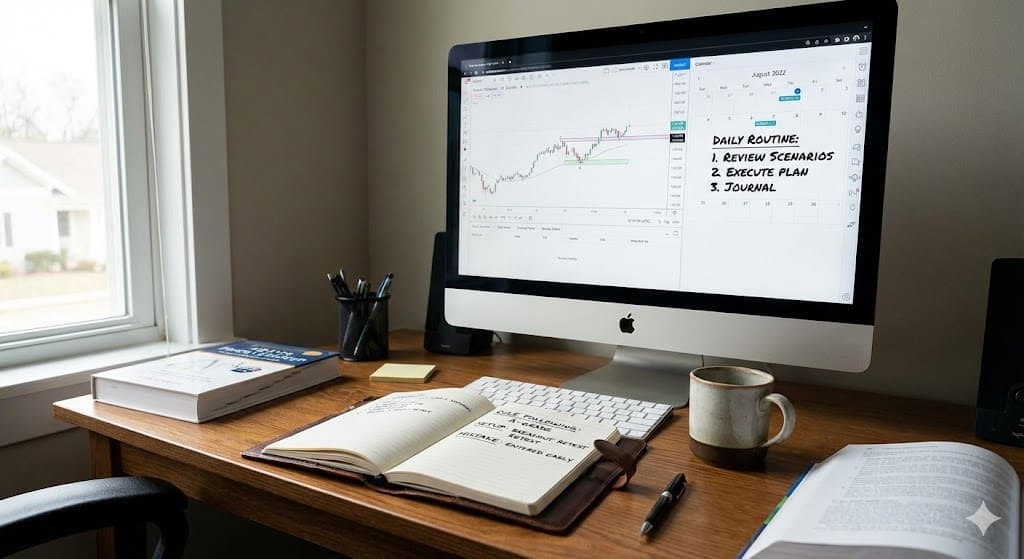
At some point, most traders hit the same wall: too many opinions, too many charts, and not enough progress that actually sticks. That’s usually the moment people decide to explore a trading academy. Not because they want shortcuts, but because they want structure, feedback, and a clearer path from “I’m trying things” to “I have a process.”
An academy can help. It can also waste months if it’s built around hype, vague promises, or constant strategy switching. The best outcome is simple: you leave with repeatable habits, solid risk rules, and a method you can execute without needing someone to tell you what to click.
“The goal isn’t more information. The goal is fewer decisions under pressure.”
The practical reason academies work
Trading isn’t hard because concepts are secret. Trading is hard because the skill is behavioral and operational: executing well, sizing consistently, and reviewing honestly. A good academy creates a loop you can repeat:
- Learn a concept in plain language
- Practice it with guardrails
- Get feedback from people who know the pitfalls
- Measure results over a real sample
- Adjust one variable at a time
If an academy does not help you build that loop, it’s basically content consumption with a membership fee.
What you should expect to gain in the first 30 days
A serious learning program should improve outcomes that are easy to verify, even if you’re not profitable yet. In the first month, the wins typically look like this:
- You stop making platform mistakes (wrong size, missing stop, wrong order type)
- Your average loss gets closer to your planned loss
- You take fewer impulsive trades
- You can explain your setups in one sentence
- You have a weekly review routine that doesn’t feel optional
“Profit is a lagging result. Execution quality is the leading result.”
A quick “is this working?” checklist
By day 30, you should be able to answer “yes” to most of these:
- I can size a trade without guessing.
- I stop immediately, every time.
- I know my max loss per day and I respect it.
- I can identify my top 2 recurring mistakes.
- I can describe my strategy and its invalidation level clearly.
If not, the issue may be the academy, your routine, or both.
Trader’s Academy roadmap: a realistic learning sequence
The fastest way to stall is trying to learn everything at once. A cleaner approach is staged learning, where each stage builds something specific.
Here is a trader’s Academy roadmap that fits most people, regardless of market:
| Stage | Focus | What “good” looks like | Typical mistakes |
| Foundations | Platform, orders, sizing | No stop mistakes, clean order entry | Demo treated like a game |
| Risk first | Loss control, limits | Planned loss matches actual loss | Moving stops, oversizing |
| One setup | Repeatable pattern | Same setup executed consistently | Strategy hopping |
| Regime awareness | Trend vs range | Fewer low-quality trades | Trading every condition |
| Review loop | Journaling and metrics | Rule grades improve weekly | Reviewing only P&L |
| Scaling | Gradual size increases | Same rules, slightly bigger size | Size jumps after wins |
You can move through this faster or slower, but skipping stages usually shows up as the same mistakes repeating with higher stakes.
“You don’t scale skill by increasing size, you do it scaling skill by reducing errors.”
Curriculum essentials that separate “training” from “content”
If you’re evaluating an academy, look at what it teaches and how it is practiced. A strong curriculum covers six areas and ties them to repetition.
Market structure and setup logic
You want clarity on:
- Why a setup exists (the market behavior behind it)
- What invalidates it (where the idea is wrong)
- When it performs poorly (regime mismatch)
If the training is mostly “take this indicator crossover,” you’ll struggle the moment conditions change.
Risk management that is measurable
Real risk education includes:
- Fixed risk per trade (in dollars or percent)
- Daily loss limits (2R to 3R is a common starting range)
- Trade limits (prevents spirals)
- Position sizing based on stop distance (not on margin)
A useful academy makes risk boring and automatic.
“If your risk rules aren’t written, they’re not rules.”
Execution and platform competence
This is underrated. The best strategy fails if you can’t execute cleanly. Good programs drill:
- Order types and when to use them
- Bracket orders (entry + stop + target)
- Partial exits and trailing logic
- Managing trades without constant tinkering
Psychology as a process tool, not a speech
Look for practical tools:
- Reset protocol after a loss
- Checklist before entries
- A/B/C grading for rule-following
- Routines that reduce FOMO triggers
Review and measurement
You should be taught to track performance in a way that leads to improvement, including:
- Outcomes in R (risk units)
- Win rate and average win/average loss (not just one metric)
- Drawdown and rule violation rate
- Results by setup and regime
Live practice and feedback
The best teaching is feedback on your actual decisions. That can include:
- Annotated chart reviews
- Office hours with trade grading
- Replay sessions (what you missed, what you chased)
- Structured drills (10-trade challenges)
Community-powered learning without turning into copy trading
Academies often include a chat, room, or forum. That can be a superpower if it’s designed well, and a distraction if it isn’t.
A good community environment is “process-first”:
- Members share thesis, invalidation, and sizing logic
- Losses are reviewed openly
- Moderators keep the room calm and focused
- “Should I buy now?” gets redirected into checklist questions
A weak community environment is “trigger-first”:
- Entries are posted without context
- Wins get celebrated, losses disappear
- Urgency is constant
- People take trades because the room is excited
“A community should sharpen your decision-making, not replace it.”
A simple rule to use community safely
Use community for:
- Context (levels, news awareness, regime notes)
- Feedback (post-trade review, rule grading)
Avoid using community for:
- Entry triggers in real time (especially early in your learning)
If you feel rushed when you open the chat, treat that as a signal to step back.
Discover your trading identity without forcing a style
One of the best reasons to join structured training is to discover your trading identity. Not in a motivational way, but in a practical way: finding the style that fits your life and your temperament.
Your “identity” is mostly constraints:
- Time available
- Tolerance for volatility
- Ability to sit through drawdowns
- Preference for fast decisions vs slow decisions
- Interest in deep research vs price action execution
A quick self-audit (answer honestly)
- Can I trade only 60–120 minutes per day, or do I have longer windows?
- Do I feel better taking fewer, higher-conviction trades, or many small trades?
- Do fast moves make me impulsive, or focused?
- Am I comfortable holding overnight risk?
- Do I enjoy reviewing trades, or do I avoid it?
Now map answers to a likely style:
| Constraint | Better fit | Why it fits |
| Limited daily time | Swing / position trading | Fewer decisions, less screen time |
| High need for action | Intraday with strict limits | Requires guardrails to avoid overtrading |
| Low volatility tolerance | Broader indices / large caps | Often smoother behavior than thin instruments |
| Strong patience | Trend pullbacks, multi-day holds | Lets edge play out without micro-management |
| Loves structure | Opening range frameworks | Clear session rules and boundaries |
This mapping reduces the chance you pick a style that fights your personality.
“Your best strategy is the one you can follow on an average day.”
Red flags that waste time (and what to look for instead)
You don’t need paranoia, but you do need standards.
Red flags
- Guarantees, certainty language, or “can’t lose” framing
- No clear risk instruction (stops and sizing are vague)
- Constant strategy changes with no testing plan
- Heavy emphasis on leaderboards without risk-adjusted context
- Live calls that encourage urgency over process
Strong signals
- Clear written rules and examples
- Repeated drilling of the same setup
- Honest loss reviews and post-session recaps
- Emphasis on invalidation and sizing
- A culture that respects “no trade” decisions
Making the decision: a practical evaluation checklist
If you’re about to explore a trading academy, run this short checklist before committing serious time:
- Is there a staged roadmap, or is it “everything at once”?
- Do they teach risk rules that can be measured?
- Do they review losses as openly as wins?
- Can they explain why a setup fails (regime mismatch)?
- Is the community moderated to reduce hype?
- Do “professional traders” in the program show process, not just outcomes?
If you can’t get clear answers, assume the learning curve will be slower than advertised.
Next step before the FAQ
If you’re ready to explore a trading academy, treat the first month like a trial built around evidence: follow the trader’s Academy roadmap, pick one setup, keep risk fixed, and use the community for feedback rather than entry triggers so you can discover your trading identity based on what you execute well under normal conditions; if you want, share your available trading hours, preferred markets, and experience level, and I’ll outline a 30-day plan with specific drills and review metrics that match your schedule.
FAQ
Is an academy necessary for a trading learning journey?
Not strictly, but it can speed progress by adding structure and feedback. The key is whether the program improves execution, risk control, and review habits, not whether it shares “better signals.”
What should I focus on first inside an academy?
Platform competence and risk rules. If you still make sizing or stop mistakes, strategy improvements won’t hold up.
How can a community-powered environment help without causing copying?
Use the community for scenario planning and post-trade review. Avoid using it as a real-time trigger source. Post your thesis and invalidation, then ask for feedback on process.
Do professional traders always make good teachers?
Not always. Good teaching shows up in clarity: explaining invalidation, sizing, and mistakes. A strong teacher helps you build independence, not dependency.
When should I add a second strategy?
After you can execute one strategy consistently over a meaningful sample and your rule-following rate is stable. Adding strategies too early usually increases confusion and overtrading.
What is the quickest sign I’m improving?
Your worst days get smaller. Average loss stays close to planned loss, and rule violations drop week over week. Profit often follows later.