Real-Time Market News Platform for Active Desks
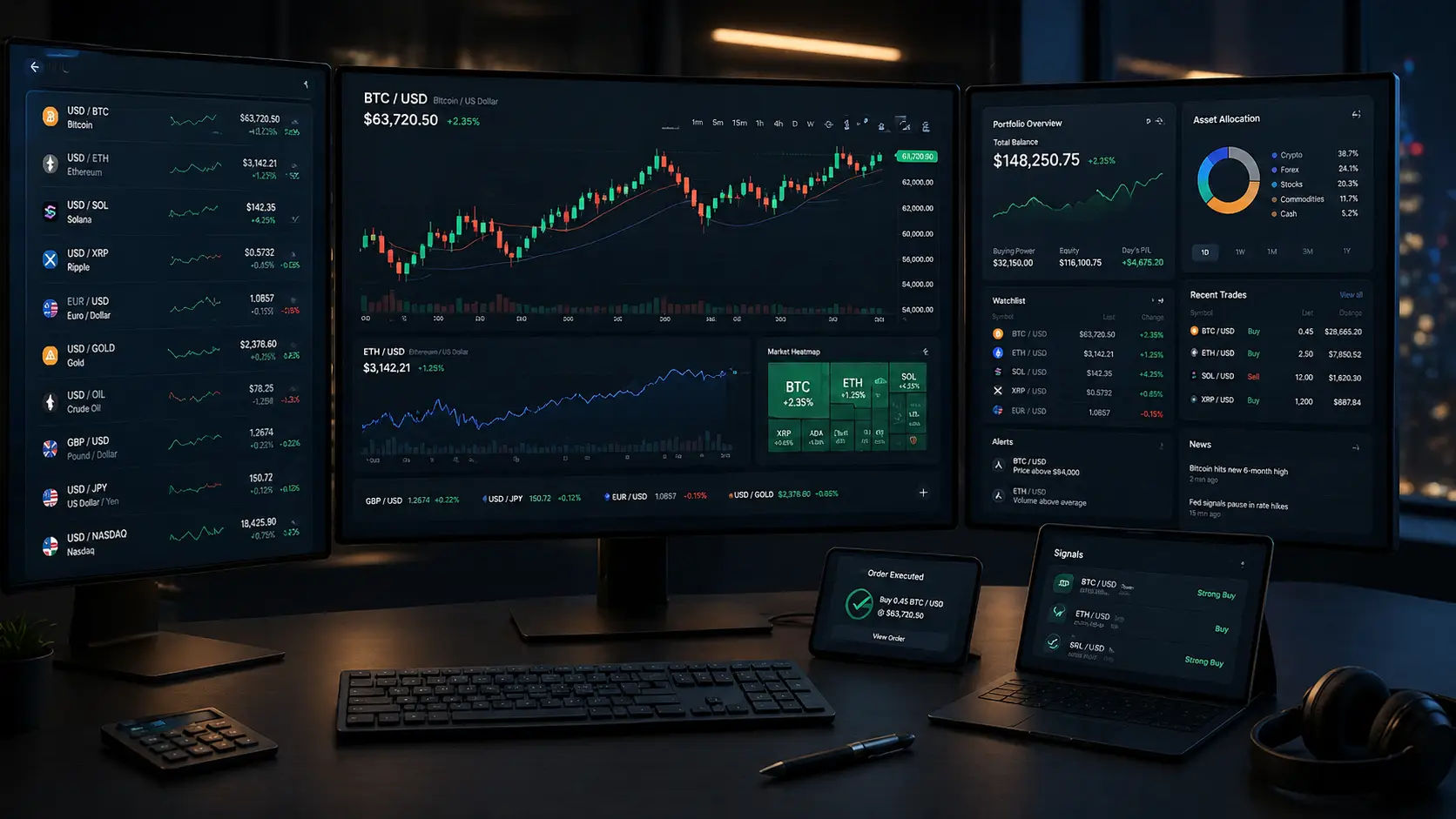
You want a real-time market news platform that cuts noise and speeds decisions. The right stack pairs headline speed with institutional market analysis tools, and feeds it into a focused trading room platform where plans, calls, and post trade notes live together.
This guide gives you a plain-English blueprint you can use to evaluate vendors or assemble your own toolkit.
What good looks like in the first five minutes
- Headlines arrive fast with readable tags
- Context appears beside the headline: instrument, session, calendar impact
- A sizing tile translates ideas into cash risk in one click
- One export matches your statement totals line by line
- A visible incident banner explains delays in plain language
Choose systems you can audit, not just admire.
Core jobs your real-time market news platform must do
| Job to be done | Non-negotiable behavior | Why it matters |
| Headline speed | Sub-second push on price-sensitive alerts | Fast beats fancy during prints |
| Relevance | Smart filters by asset, session, and severity | Cuts chatter and saves attention |
| Context | Linked chart snapshot and calendar tile | One glance beats three clicks |
| Translation | Plain-English summaries next to the raw wire | Reduces misreads under pressure |
| Traceability | Timestamp, source, and link trail | Audits and reviews stay calm |
| Stability | Status bar with incident timer | Trust survives loud minutes |
If a demo cannot show these in five minutes, live will not be kinder.
Institutional market analysis tools that actually help
Your team needs depth without drag. Pick the tools that compress research into action.
| Tool | What “good” looks like | Practical use |
| Event map | Timeline with expected impact and prior ranges | Decide to trade, fade, or stand down |
| Cross-asset monitor | FX, rates, equities, and commodities on one grid | Spot real risk-on or risk-off |
| Flow and positioning | Open interest, dealer gamma, CFTC cadence | Avoid crowded exits |
| Volatility bands | Realized and implied with simple sliders | Right-size stops and bracket targets |
| Scenario cards | If-then playbooks for key prints | Turn news into rules you will follow |
| Backtest snippets | Quick stat blocks on pattern response | Confidence without a rabbit hole |
Keep the toolkit short. Action beats encyclopedias.
Build the trading room platform around decisions, not chat
A trading room platform is a workflow. Design it like a control tower.
Room lanes
- Plan lane: two line plan per symbol with cash risk and levels
- Call lane: live entries with timestamp, stop, and bracket noted
- Review lane: before and after images, reason in and reason out
- News lane: filtered headlines with severity and session tags
Posting format everyone understands
- Plan: “EURUSD bias long above 1.0920, risk 30 dollars to 1.0905, target 1.0950 if momentum holds.”
- Call: “Long 1.0924, risk 30, bracket attached.”
- Review: “Stopped 1.0919. Second attempt only if value rebuilds. Pause five minutes.”
Short, repeatable messages keep the room focused.
Latency and load: the small numbers that decide big days
Set a budget for delays so you can measure reality.
| Item | Target | Why it matters |
| Alert push delay | Under 300 ms inside your region | Keeps calls near the price you saw |
| Chart render after alert | Under 500 ms to first paint | Context arrives while you can still act |
| Room write-read loop | Under 200 ms | Colleagues see plans before the entry |
| Status update time | Under 60 seconds | People trust receipts during incidents |
Publish the target numbers on your status page. Then test them weekly.
A simple decision loop for news minutes
- See: alert lands with severity, instrument tags, and a linked chart
- Frame: event map shows expected reaction path and prior ranges
- Size: risk in cash with a bracket preset
- Act: trade a retest, not the first spike
- Record: two screenshots, two lines, export-ready log
Trade the second chance after prints. Let brackets do the heavy lifting.
Starter layouts that reduce clicks
One-screen layout
- Left: filtered headlines with severity badges
- Center: primary chart with session marks and a simple value guide
- Right top: sizing tile in cash, bracket presets
- Right bottom: room feed with plan and call lanes
Two-screen layout
- Screen 1: news, chart, and sizing
- Screen 2: trading room and review lane
Keep it boring. Boring wins under pressure.
Risk rules that protect the month
- Per day loss cap that pauses new orders until server reset
- Max open positions per symbol to avoid concentration
- Session filters near hot prints for the first three minutes
- Two attempts per idea, then stand down
- Plain messages when rules fire
Cost lines to track for a full month
| Cost line | Where it hides | What to do |
| Data and news | Vendor tiers and region adds | Buy only what changes outcomes |
| Spread and commission | Ticket and fills | Trade core minutes, avoid chasing |
| Slippage around prints | Entry and exit logs | Prefer retests, size down near events |
| Time lost to incidents | Status and room transcripts | Drill failovers and post timelines |
| Review time | Archiving and exports | One-click capture and CSV parity |
Clarity turns uncertainty into a choice you can live with.
Playbook for common news scenarios
Inflation print higher than expected
- Default: risk-off tone, dollar firm, equities and gold wobble
- Plan: trade a retest in USD majors or gold after first spike
- Size: keep cash risk small and widen brackets slightly
Surprise central bank pause
- Default: relief rally on equities, currency fades vs higher yielders
- Plan: pick the clearest index or FX pair and wait for a retest
- Size: reduce initial risk and add only after the first bracket pays
Inventory shock in oil
- Default: sharp one-way push with quick retrace
- Plan: skip the first spike, take the first measured pullback
- Size: keep stops honest and avoid thin late sessions
Short patterns, repeatable rules.
Quick vendor checklist you can copy
Must have
- Filters that truly silence irrelevant feeds
- Linked charts and calendar context in one click
- Latency metrics on a public status page
- Export parity with statement totals
- Room tools with lanes for plan, call, and review
Nice to have
- Audio squawk with short, human reads
- Scenario cards attached to recurring events
- Lightweight API for dashboards and alerts
If three or more must-haves are missing, keep shopping.
FAQ
Do I need multiple news vendors
Often one solid feed with smart filters and a reliable squawk is enough. Add a backup only if your risk window demands redundancy.
Which institutional market analysis tools are worth it first
Start with an event map and volatility bands. They turn raw headlines into measured sizing and timing.
How is a trading room platform different from chat
A room enforces lanes for plan, call, and review, uses cash risk language, and outputs exports that match statements. Chat does not.
How do we cut slippage around prints
Trade retests, not first spikes, and size down near the event. Use session filters to delay entries for a few minutes when it matters most.
What proves the platform is trustworthy
Latency metrics on a status page, exports that equal statements, and incident logs with start, fix, and planned revert times.
A quiet nudge before you commit
Write a one page plan that lists your target sessions, three event types you will trade, the latency budget you expect, and the two institutional market analysis tools you will actually use. Then pick the real-time market news platform and trading room platform that make those habits effortless and your reviews boring in the best way.